What actually determines how a quicklime slurry behaves once it’s made?
Quicklime slurry is a suspension made by mixing calcium oxide (CaO) with excess water in a highly exothermic reaction, producing calcium hydroxide. Its performance is shaped by three variables — the quicklime’s own burn properties, the quality of the mixing water, and the slaking temperature — which together determine particle size, viscosity, and how quickly the slurry reacts once it’s in use.
What Is Quicklime Slurry?
Definitions of “slurry” vary across the lime industry, but for this discussion, quicklime slurry refers specifically to a product made by starting with calcium oxide (quicklime) and adding water in excess — enough to produce a pourable, pumpable liquid rather than a dry or paste-like material.
The reaction that creates it is highly exothermic: CaO plus H₂O yields calcium hydroxide plus heat. The finished product is a suspension, not a true solution — meaning solid particles remain dispersed throughout the liquid rather than dissolving into it.
Read more about key tests for quicklime slurry
Typical Characteristics of Quicklime Slurry
Variable particle size. The fine solids suspended in the slurry can range widely in size depending on the slaking conditions used to produce them. Particle size matters more in some applications than others — it’s rarely a critical factor in road construction, but it becomes important in applications that depend on a fast reaction, such as acid mine drainage treatment or water treatment.
Some inert material. Because quicklime is a natural material sourced from the earth, it can carry inert constituents — such as calcium carbonate or silicates — that don’t contribute to the active chemistry. These are typically easy to screen out, but knowing they’re present helps determine whether screening is worthwhile for a given use.

Cost efficiency. Quicklime is the first product created in the lime cycle, produced directly from calcination with no further processing. Less processing generally means lower cost, so quicklime slurry — whether self-produced on-site or delivered pre-made — tends to be a more economical option than more heavily processed lime products.
Operational complexity. Producing and handling quicklime slurry isn’t as simple as combining quicklime and water. Its properties, the water used, and the temperature at which it’s made all interact to determine the final product’s behavior — which is why understanding the factors below matters before committing to a quicklime slurry system.
Three Factors That Shape Quicklime Slurry Performance
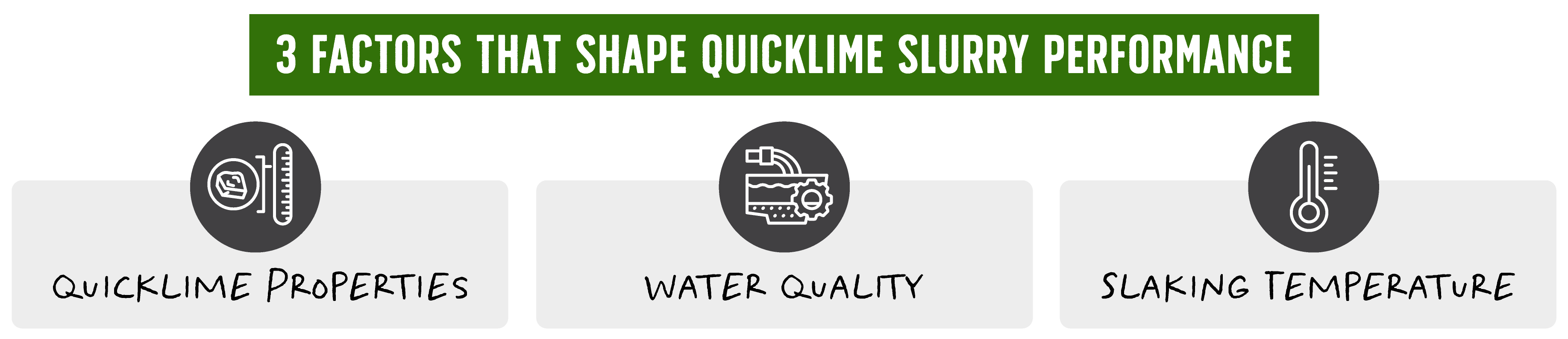
Three variables largely determine how a given batch of quicklime slurry behaves: the properties of the quicklime itself, the quality of the water used to make the slurry, and the temperature at which slaking takes place.
Quicklime Properties
As a natural material, quicklime carries some inherent variability in its chemical makeup. But the calcination process itself also shapes the final product — specifically, whether the result is hard-burned or soft-burned quicklime.
Hard-burned quicklime is produced at higher kiln temperatures or with longer exposure time, resulting in a less porous, less reactive material. Soft-burned quicklime is produced at lower temperatures or shorter retention time, yielding a more porous material with a faster reaction rate.
That reaction speed carries through the rest of the process: a faster, hotter-slaking quicklime tends to produce finer particles, which drives up the slurry’s viscosity. A slower-reacting quicklime produces coarser particles and lower viscosity. Which outcome is preferable depends entirely on the intended application.
Water Quality
What’s dissolved in the mixing water matters. Certain constituents — sulfates and magnesium in particular — slow the reaction between quicklime and water. A slower reaction generates less heat, and less heat during slaking generally results in larger particle sizes in the finished slurry.
Water temperature is a factor as well, and one that shifts seasonally. A slurry mixed with water at 40°F after a Texas cold snap won’t behave the same as one mixed with water near 100°F in the middle of summer.
Slaking Temperature
Comparing a cold slake (roughly 40°F) to a room-temperature slake (roughly 75°F) shows a clear pattern: the warmer slake reaches a higher temperature in a shorter period of time. That faster, hotter reaction drives particle size down, producing a slurry that reacts more quickly once it’s introduced into a system — whether for acid neutralization, pH adjustment, or alkalinity addition.
A colder, slower slake takes longer to reach its peak temperature and produces a coarser particle size distribution, which can reduce reactivity. The practical difference shows up clearly in particle size distribution data: a room-temperature slake yields a higher volume of fine particles, while a cold slake produces more coarse particles. For soil stabilization, where reactions play out over weeks or months, that difference in reaction speed rarely matters. For water treatment applications — acid neutralization, industrial process water softening — high reactivity is essential to treating water effectively as it moves through the system.
Getting the Most Out of a Quicklime Slurry System
Beyond understanding the chemistry, a few operational factors determine whether a quicklime slurry system succeeds long-term:
- Confirm it’s the right fit. Quicklime slurry is exothermic and requires appropriate mixing capability. Before committing, confirm the system can handle the operational demands and that the resulting reaction speed matches the application.
- Maintain the dosing system. Whatever equipment delivers the slurry needs regular upkeep to keep dosing consistent and reliable.
- Test performance regularly. Ongoing testing confirms the slurry’s quality is holding steady over time and that it continues to perform as needed on the job.
Does Particle Size Matter for Every Quicklime Slurry Application?
No. Particle size is only critical for applications that depend on a fast, high-speed reaction — such as acid mine drainage treatment or water treatment. In slower, longer-timeline applications like soil stabilization, where the reaction plays out over weeks or months, particle size has little practical effect on outcomes.
Have questions about quicklime slurry or how to determine the right product for your application? Contact the Lime Association of Texas at DaleRand@limetexas.org, and follow LAT on LinkedIn and subscribe on YouTube for future episodes.