How lime supports cleaner air, safer water, and healthier communities.
Lime plays a critical role in protecting two of our most essential resources: air and water.
While it is often associated with steel production and construction, some of lime’s most important applications happen behind the scenes: in emissions control systems, water treatment facilities, mining operations, and wastewater plants. In many cases, lime is the material that prevents pollutants from entering the environment in the first place.
Air Quality: Removing Sulfur from Emissions
One of the largest environmental uses of lime is in flue gas treatment systems at power plants and other industrial facilities.
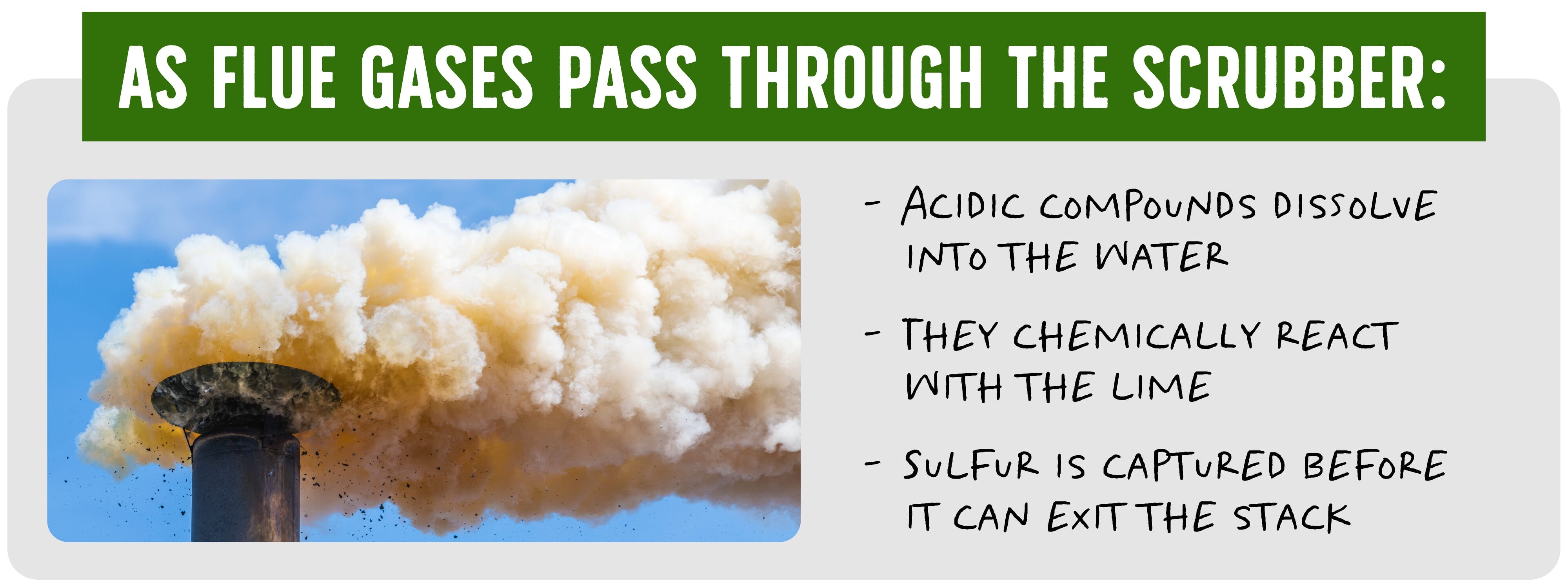
Coal contains sulfur compounds, so burning it for power will always generate sulfur dioxides that must be captured—or else will end up in the atmosphere. To control these emissions, facilities use a scrubbing system that creates a slurry of lime or limestone. As flue gases pass through the scrubber:
- Acidic compounds dissolve into the water
- They chemically react with the lime
- Sulfur is captured before it can exit the stack
These systems are highly effective (often 96-99+% efficient) at removing sulfur dioxide. In fact, the mass removal of sulfur from flue gas remains one of the single largest environmental uses of lime.
The Acid Rain Problem
The importance of sulfur removal became clear in the 1970s, when acid rain began damaging ecosystems across the northeastern United States.
In parts of upstate New York, rainwater pH levels dropped to approximately 5.5–5.7, making lakes too acidic to support fish populations. Emissions from power plants were traveling through the atmosphere and returning to the ground as acidic precipitation.
By dramatically reducing sulfur emissions through lime-based scrubbers, industries helped curb one of the most serious environmental threats of the era.
Smaller Industrial Facilities: Controlling Stack Emissions
Lime is not only used in large power plants. Smaller industrial operations also rely on lime to capture harmful compounds before they are released into the air.
For example, in brick manufacturing:
- Clay deposits can contain trace heavy metals and halides
- During firing, high temperatures drive off chlorides, fluorides, and other compounds
- Hydrated lime is injected into the exhaust stream
- The lime reacts with acidic gases while traveling through the system
- The reacted particles are captured in a baghouse filtration system
This process allows facilities to trap chlorides and fluorides effectively, reducing emissions and protecting air quality.

Managing Hard Water Treatment
Lime is also widely used in water treatment applications.
In regions where water passes through limestone formations, such as areas around Austin, dissolved calcium and magnesium can create hard water. Hard water can:
- Interfere with soaps and detergents
- Cause scale buildup
- Impact industrial systems
Lime treatment can help manage hardness and improve overall water chemistry. Not every municipality is required to use lime, but many choose to because of its effectiveness and reliability.
Removing Metals from Water
Lime is particularly valuable for removing dissolved metals from water supplies and wastewater.
By raising the pH, often closer to 10, lime causes many metals to become insoluble. This allows them to precipitate out of solution so they can be removed.
Metals that can be treated this way include:
- Iron
- Cobalt
- Radium
- Arsenic
Lime treatment can also help remove phosphates and sulfates, improving water quality before discharge or distribution.
Mining and Acid Neutralization
In mining operations—particularly in coal mining regions of the Northeast—lime is used to neutralize acidic drainage.
When water interacts with exposed minerals in mine sites, it can become acidic and carry dissolved metals such as iron and arsenic. Lime raises the pH, causing these metals to precipitate and reducing environmental harm.
This neutralization process is essential to restoring and maintaining water quality near mining areas.
Wastewater and Sludge Treatment
Lime also plays a role in wastewater and sludge management.
Depending on the type of wastewater, lime can:
- Stabilize sludge
- Reduce pathogens
- Control odors
Hydrogen sulfide, which can create strong “rotten egg” odors in storm sewers and wastewater systems, can be controlled through lime addition. By adjusting pH levels, lime reduces the formation and release of these gases.
A Material That Protects What Matters Most
From capturing sulfur before it enters the atmosphere to removing metals from drinking water, lime serves as a frontline defense in environmental protection.
While many of these applications happen out of sight, they have measurable impacts on public health, ecosystem stability, and regulatory compliance.
Air and water are foundational resources. Lime helps ensure they remain safe, stable, and sustainable for communities across Texas and beyond.