• Skip to main content
  • Skip to footer
Lime Association or Texas
Login
Call us 512-771-3667
Email at DaleRand@limetexas.org
Watch LIME
  • About Us
  • Resources
  • Podcasts
  • Calculators
  • Blog
  • Contact Us
  • Login
  • Portal
Workers laying fresh asphalt, using shovels to spread and level dark gravelly material on a road surface. Their heavy boots suggest a labor-intensive task.

Three Phases of Successful Lime Stabilization

After 40 years in this industry, including more than 26 years with TxDOT and a decade as a consulting engineer, I’ve investigated a lot of pavement failures. Almost every one of them traced back to the same root causes: design, materials, and construction.

I like to call it the three-legged stool. A stool only works when all three legs are the same length. Shorten one, and the whole thing goes unstable. I’ve found the same holds true on every subgrade project I’ve ever worked on — and really, on any type of roadway construction.

Phase 1: Design

Design is the first and most critical phase. Without a sound design, nothing else compensates.

For subgrade stabilization, that starts with a geotechnical investigation to understand what native materials you’re working with before you decide on a stabilizer type, a percentage, or a placement depth. The investigation tells you whether stabilization is even needed — and if it is, exactly what’s required.

Drainage is equally important and often overlooked. Even a well-specified lime treatment at the correct depth and percentage can fail if the pavement system doesn’t manage water properly. Water getting beneath a stabilized subgrade undermines the foundation regardless of how well the other two phases were executed.
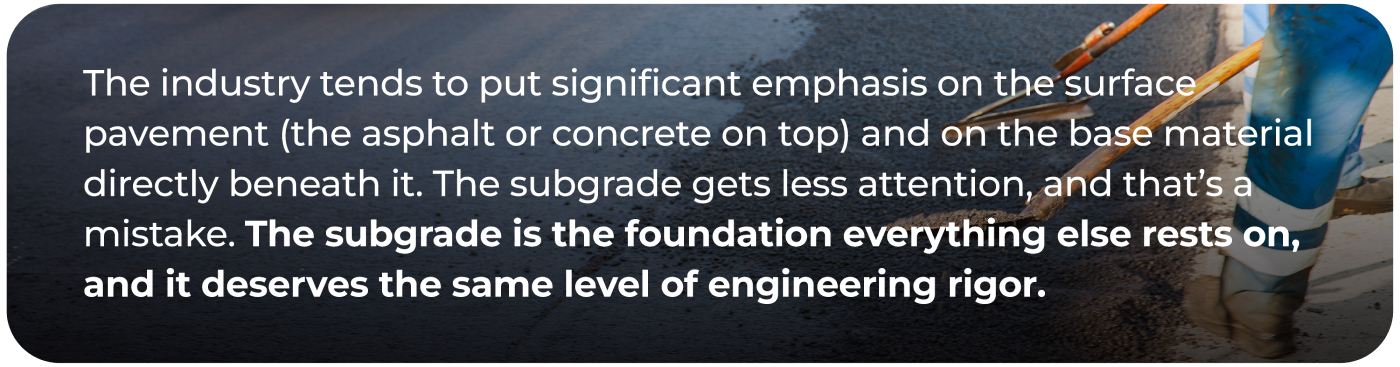
The industry tends to put significant emphasis on the surface pavement (the asphalt or concrete on top) and on the base material directly beneath it. The subgrade gets less attention, and that's a mistake. The subgrade is the foundation everything else rests on, and it deserves the same level of engineering rigor.

The industry tends to put significant emphasis on the surface pavement (the asphalt or concrete on top) and on the base material directly beneath it. The subgrade gets less attention, and that’s a mistake. The subgrade is the foundation everything else rests on, and it deserves the same level of engineering rigor.

Phase 2: Materials

Once the design is established, the materials phase is about making sure what goes into the ground matches what was specified.

In Texas, TxDOT’s Materials Producer List (MPL) is a reliable starting point for lime. Sourcing from an approved supplier gives you reasonable confidence the material meets specification. But the MPL doesn’t guarantee the lime was applied at the right percentage or to the right depth — those decisions come from the design. No approved supplier list compensates for a design that didn’t define them correctly.

This applies across stabilizer types. Whether the project calls for lime, cement, or something else, material quality is only one variable. It has to be the right material, at the right rate, placed correctly.

Phase 3: Construction

Construction is where designs and materials either get realized or get undermined. I’ve seen projects with sound designs and proper materials still fail because the construction phase wasn’t executed correctly. Common problems include mixing too deep or not deep enough, insufficient water during the mellowing process, and failure to follow established procedures.

Two principles I come back to constantly on the construction side:

  1. What gets measured gets done. In-place density, mixing depth, lime percentage — if these are critical to the project’s success, they need to be in the specifications and actively measured during construction.
  2. If you expect it, inspect it. If a requirement matters enough to specify, it matters enough to verify in the field.

Mixing It All Together…

Whether you’re planning a new project or conducting a forensic investigation on a failed one, this framework gives you a structured place to start. In my experience, virtually every failure traces back to at least one of these three phases.

For a deeper look at how these principles apply specifically to lime stabilization — including how to determine the right lime percentage, mixing depth, and water content — click here. To learn more about lime stabilization or to reach me directly, email dalerand@limetexas.org.

About the Author

Dale Rand, Executive Director

Dale Rand, P.E. is the Executive Director of the Lime Association of Texas. With more than 40 years in the industry — including over 25 years with TxDOT and a decade at Atlas Technical Consultants — Dale has designed more than 300 hot mix asphalt mixtures and has seen firsthand what lime can do when it’s used correctly, and what happens when it isn’t. He joined Lime Association of Texas in 2023 with a simple vision: make this a practical, trustworthy resource for engineers, contractors, and anyone working with lime in Texas.


By: 06/18/26 Category:

Lime Association Of Texas

Call us 512-771-3667

Email at DaleRand@limetexas.org

Lime Promotional Video

X

Watch LIME

Navigation Menu

  • Home
  • About Us
  • Resources
  • Calendar
  • Calculators
  • Blog
  • Contact Us

Our Mission

The Lime Association of Texas (LAT) represents the collective interests of an industry with a long history of service to the State of Texas. Quality, integrity and responsive action to the customers and governmental agencies of Texas are the hallmark of the LAT mission. The member companies engage in the manufacture of high quality lime products and guide the efforts of the industry through participation in the LAT to the benefit the end users of lime.

-Dale A. Rand P.E., Executive Director

Copyright ©  2026 The Lime Association of Texas. All Rights Reserved.

The materials and information contained herein are for general guidance and reference purposes only for professionals competent to evaluate the significance and limitations of their content. The materials and information do not constitute a standard, specification, or regulation. Third party materials reflect the views of the authors, who are responsible for the accuracy of the facts, data, opinions, findings, and conclusions presented therein. The contents do not necessarily reflect the official views or policies of the Lime Association of Texas.

Manage Consent
To provide the best experiences, we use technologies like cookies to store and/or access device information. Consenting to these technologies will allow us to process data such as browsing behavior or unique IDs on this site. Not consenting or withdrawing consent, may adversely affect certain features and functions.
Functional Always active
The technical storage or access is strictly necessary for the legitimate purpose of enabling the use of a specific service explicitly requested by the subscriber or user, or for the sole purpose of carrying out the transmission of a communication over an electronic communications network.
Preferences
The technical storage or access is necessary for the legitimate purpose of storing preferences that are not requested by the subscriber or user.
Statistics
The technical storage or access that is used exclusively for statistical purposes. The technical storage or access that is used exclusively for anonymous statistical purposes. Without a subpoena, voluntary compliance on the part of your Internet Service Provider, or additional records from a third party, information stored or retrieved for this purpose alone cannot usually be used to identify you.
Marketing
The technical storage or access is required to create user profiles to send advertising, or to track the user on a website or across several websites for similar marketing purposes.
  • Manage options
  • Manage services
  • Manage {vendor_count} vendors
  • Read more about these purposes
View preferences
  • {title}
  • {title}
  • {title}