With Insights From Industry Expert Dr. Kevin Ingram
When most people hear the word lime, they may think of citrus fruit or perhaps a white powder used in construction. But lime is far more than that. It is one of the most widely used industrial materials in the world, with applications that stretch from ancient architecture to modern steelmaking, from environmental protection to everyday food products.
Dr. Kevin Ingram, a lime industry professional with more than three decades of experience and an academic background in chemical engineering and analytical chemistry, has worked across many areas of the field. His perspective highlights just how essential lime is to both industry and daily life.
The Biggest Uses of Lime Today
Lime plays a critical role across many industries, but several applications account for the majority of its use.
Steel Manufacturing
The single biggest use of lime in the United States is steel production. More than 30% of all lime produced is used in steelmaking, where it acts as a flux to remove impurities such as silica, phosphorus, and sulfur. This helps manufacturers produce cleaner, stronger steel.
Environmental Applications
Lime is also widely used to protect the environment through:
- Drinking water treatment
- Wastewater neutralization
- Air pollution control systems, including flue gas desulfurization
Its natural chemistry makes lime highly effective at controlling acidity and removing contaminants.
Roads and Infrastructure
Lime is a key material in building durable roads and highways. Common uses include:
- Soil stabilization
- Asphalt modification
- Aggregate treatment
In pavement construction, lime improves strength and longevity, helping roads resist cracking and moisture damage.
Mining and Nonferrous Metals
Beyond steel, lime is used in processing metals such as gold and copper. It helps regulate pH levels and supports efficient mineral separation during extraction and refining.
Building Materials
Lime has been used in construction for thousands of years and remains important today in:
- Mortars
- Stucco
- Structural applications requiring improved stability
Its ability to strengthen materials and enhance workability makes it a longstanding building essential.

Lime’s More Unexpected Uses
While lime is best known for heavy industry, it also appears in surprising everyday applications—even food production!
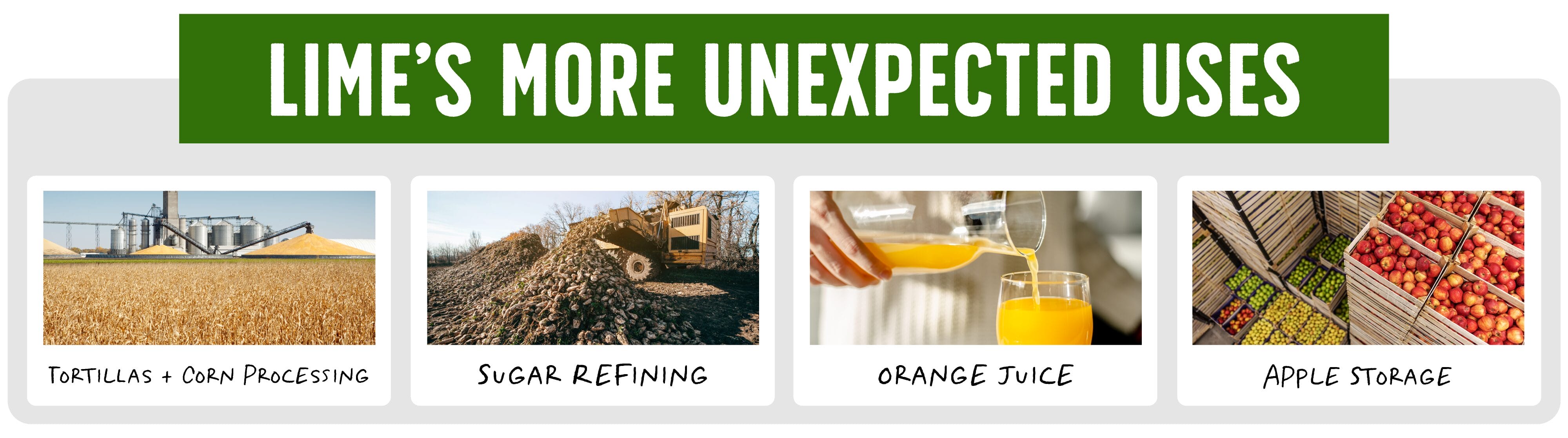
Tortillas and Corn Processing
One of the most fascinating uses of lime is in tortilla production. Lime is used in a process called nixtamalization, which breaks down corn into masa. This process not only improves texture and flavor, but also increases nutritional value by releasing vitamin B (niacin), helping prevent deficiencies.
Sugar Refining
In sugar processing, lime is used to dissolve and bind impurities so they can be filtered out, producing a cleaner final product.
Orange Juice
Calcium carbonate, derived from limestone, is commonly added to orange juice to increase calcium content.
Apple Storage
Hydrated lime can absorb carbon dioxide in storage environments, helping preserve apples and extend shelf life.
Lime Through History: An Ancient Discovery
Lime is not a modern invention. Nearly every ancient culture developed a word for lime, likely because it was discovered independently in many regions.
Early humans may have first encountered lime in limestone cave environments. Fires heated the rock, rainwater reacted with it, and the material crumbled into powder. When mixed with water, it hardened again—forming an early version of cement.
The earliest recorded uses of lime were tied to construction and manufacturing, including:
- Whitewash in Anatolia (modern-day Turkey)
- Early glassmaking in Syria, using limestone, sand, and heat
- Roman concrete
Even today, glass production remains one of the major uses of limestone.
A Material That Connects Past and Future
From ancient whitewashed walls to modern highways, from steel plants to tortillas, lime remains one of the most versatile materials in human history.
As demand grows for durable construction, cleaner water, and more sustainable industrial processes, lime’s role will only become more important. The Lime Association of Texas is proud to support an industry rooted in history and focused on the future, helping ensure that this versatile material continues to serve communities across Texas and beyond.